


How Solar Energy Powers Eco-Friendly Resorts
Solar energy is transforming resorts by reducing carbon emissions, cutting costs, and meeting the growing demand for eco-conscious travel. Here's how:
- Replacing diesel generators with solar panels, battery storage, and creative solar systems generates clean energy.
- Solar setups power everything from guest villas to water desalination, while significantly reducing operational costs.
- Travellers increasingly prefer resorts with sustainable practices, creating a strong business case for solar investments.
Despite challenges like high setup costs and weather variability, advancements in solar technology and partnerships are helping resorts overcome these hurdles. As a result, the shift to solar is no longer just an energy solution - it's reshaping the hospitality industry.
How Solar Technology Powers Resorts
More resorts are turning to solar technology to generate electricity, store excess energy, and power guest amenities. By integrating these systems, resorts can reduce their dependence on fossil fuels while keeping operations running smoothly.
Solar Panels for Energy Generation
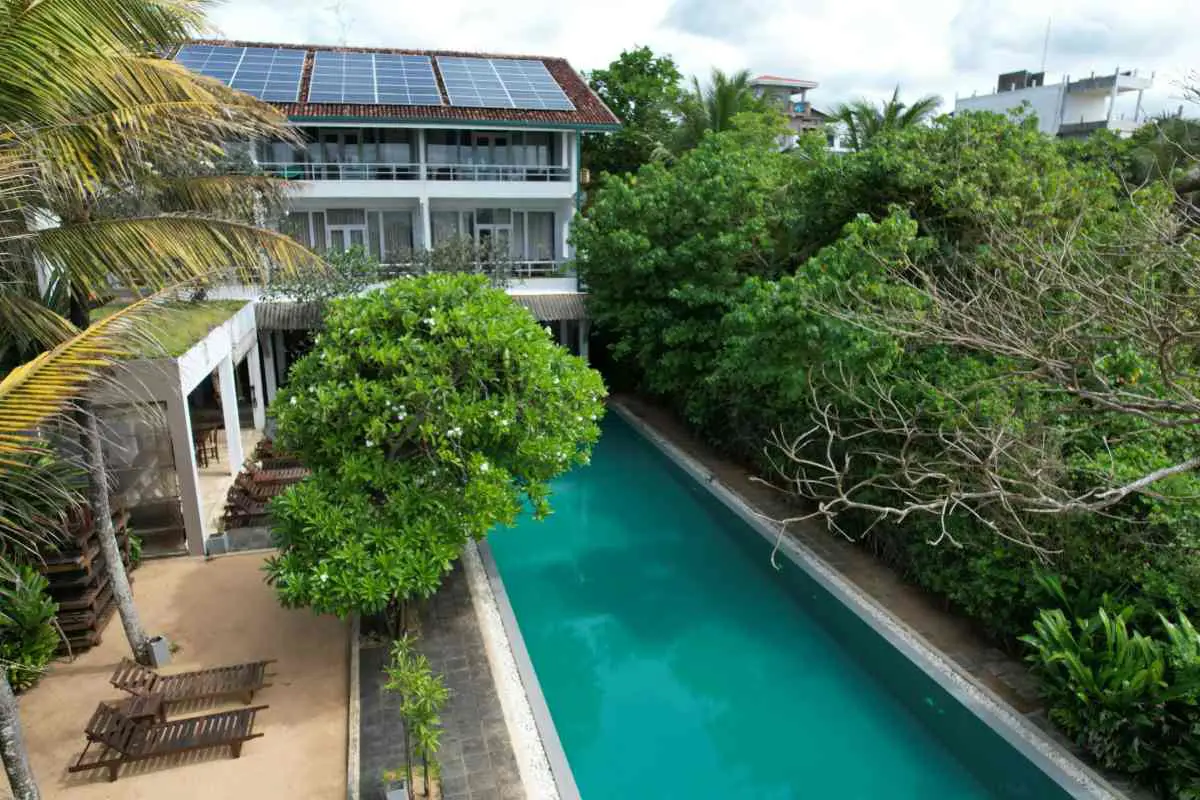
Photovoltaic panels are essential to adopting solar energy in resorts. The rooftops of guest villas, restaurants, and staff quarters are ideal locations for installation. The Ritz-Carlton Maldives at the Fari Islands, for example, has generated 983 kW of energy from its rooftop solar panels. Meanwhile, Patina Maldives has developed an impressive 2 MW capacity from similar installations.
In areas with limited space, resorts use creative solutions such as floating solar platforms. The Fari Islands, for instance, use 40 floating platforms equipped with 2,160 photovoltaic modules to meet 24% of their energy needs. They aim to triple their solar capacity to 6.4 MW by the end of 2026, which could cover half of their electricity demand on sunny days.
Ground-mounted solar farms are another effective approach, offering high energy output. In April 2023, the Royal Son Bou Family Club in Spain launched a solar park with 2,424 panels spread across 5,533 square metres. The €1.3 million project delivers 1.1 MW of power, meeting 91.8% of the resort's energy needs and reducing CO₂ emissions by around 930 tonnes between April and December 2023.
At Six Senses Ninh Van Bay in Vietnam, solar panels have been installed in an agrivoltaic setup. Launched in August 2022, this project comprises 800 solar panels mounted on a hillside, enabling crops to be cultivated beneath them. This dual-purpose system has produced 229,127 kWh of electricity, covering 17% of the resort's energy requirements, and yielded 580 kg of vegetables from 31 different crops.
Battery Storage and Energy Management
Resorts rely on advanced battery systems to maximise solar energy use. These systems store surplus energy for use at night or during periods of cloud cover. Toberua Island Resort in Fiji, for instance, uses 232 solar panels and 18 lithium batteries to power the entire island. This hybrid system has cut diesel consumption by 150 litres per day and reduced carbon emissions by 95%, saving approximately 185 tonnes of CO₂ each year.
Larger resorts require even more robust storage solutions. In June 2024, Soneva Resorts in the Maldives expanded their solar capacity with a $10 million investment from Aareal Bank. Soneva Fushi now operates with 2.55 MWp of solar power and 2.7 MWh of battery storage, while Soneva Jani has 2.75 MWp of solar capacity paired with 2.0 MWh of battery storage.
Solar-Powered Amenities
Solar energy doesn't just power the essentials; it can also support luxury amenities. The Four Seasons Safari Lodge Serengeti in Tanzania, for example, is entirely off-grid thanks to the region's largest solar farm, completed in July 2024. With 2,256 panels and a 1 MW inverter, this installation has cut diesel consumption by over 640,000 litres a year.
Solar systems also support essential services such as water desalination and electric water heating. Toberua Island Resort uses its solar setup to power a reverse osmosis desalination plant and has replaced gas water heaters with solar-powered electric ones.
Meanwhile, at the Holiday Inn Resort Kandooma, solar panels generate 306,601 kWh of electricity each year—enough to power all the guest villas for 32 days or charge 11,000 laptops daily.
Benefits of Solar-Powered Resorts
Reducing Carbon Emissions
Switching to solar energy can significantly reduce resorts' reliance on fossil fuels. Take the Holiday Inn Resort Kandooma in the Maldives, for example. In September 2020, the resort installed a photovoltaic system comprising 596 solar panels spread across 1,283 square metres. This system generates 306,601 kWh of electricity each year, reducing CO₂ emissions by 215 tonnes. To put this into perspective, this is equivalent to offsetting the CO₂ absorption of 9,360 trees, or the emissions from 172 one-way flights between London and Malé. In addition to the environmental benefits, the resort now saves over 81,000 litres of diesel each year — enough fuel to drive a car for one million kilometres.
Lowering Operating Costs
Solar energy is good for the planet and makes financial sense. Although the initial cost of installing solar panels can be high, the long-term savings on fuel costs are undeniable. This is particularly important for remote island resorts, which typically rely on costly diesel deliveries. By switching to solar power, these resorts can significantly reduce their operational expenses.
Six Senses Ninh Van Bay is a prime example of how to maximise solar installations. Their agrivoltaic system generates electricity and reduces food procurement costs by growing fresh produce on-site. Guests can enjoy meals made with these locally grown ingredients, which adds a special touch to their dining experience.
Attracting Eco-Conscious Guests
Demand for sustainable travel is growing rapidly. A 2022 report found that 78% of travellers actively seek eco-friendly accommodation. Solar-powered resorts are well placed to meet this demand, as they can demonstrate their commitment to sustainability.
They are also enhancing the guest experience with educational and interactive programmes. For example, guided tours of solar farms give visitors a behind-the-scenes look at how renewable energy supports local agriculture. Culinary teams explain how local produce is used in meals, strengthening guests' connection to the resort's sustainability efforts. Some resorts even have "Alchemy Bars", where guests can make spa products using organic ingredients grown beneath the solar panels. These hands-on experiences bring sustainability to life, turning it into an engaging and memorable part of the stay.
Challenges and Future Trends in Solar-Powered Resorts
Challenges in Solar Implementation
One of the most pressing issues for resorts looking to adopt solar energy is the initial cost. Depending on size and location, installing a 1-megawatt solar system can set a resort back anywhere from €1.4 million to €2.3 million. Although the payback period is usually four to seven years, smaller resorts often struggle to secure the initial funding. For remote island resorts such as those in the Maldives, costs are even higher due to shipping and installation expenses.
Weather variability also poses a significant challenge. In Germany, for example, solar panels only operate at full capacity for between 980 and 1,030 hours per year – around 10%. During Dunkelflaute periods, when both solar and wind energy are minimal, resorts must depend on backup power sources. Other factors, such as reduced solar output due to Sahara dust or panels overheating and losing efficiency in high temperatures, add to the complexity. Limited space can also restrict how much solar energy a resort can generate, with some systems covering only a fraction of their energy needs.
Nevertheless, advancements in solar technology are paving the way for more efficient and adaptable solutions.
Emerging Trends in Solar Technology
New technologies are helping resorts to overcome their traditional limitations. For instance, bifacial solar panels are becoming increasingly popular in alpine resorts. These panels capture sunlight from both sides and use reflected light from surfaces such as snow, sand or water to boost energy output by up to 30%.
Floating solar systems offer a clever solution to space constraints, particularly for island resorts. Meanwhile, the cost of battery storage systems has plummeted by 85% since 2010, making it easier for resorts to store solar energy for later use.
AI-powered energy management systems are also making a difference. These systems optimise energy usage by scheduling high-energy tasks, such as water pumping or ice making, during peak solar production hours. Additionally, building-integrated photovoltaics (BIPV), such as transparent solar glass for gondola windows or solar-integrated lift structures, transform resort infrastructure into energy-generating assets. These innovations address energy challenges while aligning with the luxurious aesthetics that many resorts aim to maintain.
Conclusion
Resorts such as the Four Seasons Safari Lodge Serengeti and the Holiday Inn Resort Kandooma have demonstrated that adopting solar power can reduce CO₂ emissions by hundreds of tonnes each year without compromising guest comfort. Solar energy now powers much more than just lights and air conditioning; it supports everything from desalination systems to agrivoltaic farms, demonstrating its versatility.
With 78% of travellers now prioritising sustainability, choosing resorts with proven green credentials can speed up the transition to renewable energy sources. However, identifying genuine eco-friendly initiatives can be challenging. This is why certifications such as EarthCheck, Green Globe or LEED — endorsed by the Global Sustainable Tourism Council — are vital for making informed travel choices.
Solar-powered resorts not only cut emissions, but also reinvest their savings in meaningful initiatives such as wildlife conservation, community education and local job creation. Platforms like Exploreo support these efforts by offsetting travel emissions through tree planting and funding renewable energy projects, so your stay can contribute to environmental and social progress.
Every booking matters. As mentioned earlier, these choices encourage the hospitality sector to further innovate with renewable energy solutions. The future of travel depends on thoughtful decisions that safeguard the destinations we treasure. Solar-powered resorts offer a practical way to reduce tourism's environmental impact while providing the comfort and experiences modern travellers seek.
Switching to solar energy offers resorts a practical way to slash operating costs by reducing their dependence on costly diesel and traditional electricity sources. For example, some resorts save up to 81,000 litres of diesel every year, which not only cuts fuel expenses but also prevents more than 215 tonnes of CO₂ emissions. For larger solar installations, the benefits grow even more impressive, with the potential to generate up to 1.1 million kWh of solar power, significantly lowering energy bills and promoting greener operations.
Eco-friendly resorts are stepping up their game with modern energy storage solutions to keep the power supply reliable, even when the sun isn't shining. Solar panels take centre stage, generating electricity during sunny days. Any extra energy produced doesn't go to waste - it's stored in high-capacity lithium-ion batteries. These batteries serve as a backup, delivering energy during cloudy weather or nighttime when sunlight isn't available.
Solar farms that embrace a nature-friendly design take deliberate steps to safeguard and enhance local wildlife habitats. For instance, areas around the site are often planted with native wildflowers, hedges, and bushes, providing shelter and food for insects, birds, and small mammals. Solar panels are typically installed on elevated structures, allowing vegetation to grow naturally underneath and giving larger animals the freedom to roam.
To keep environmental impact to a minimum, regular ecological monitoring programmes are conducted. These programmes monitor biodiversity and track population changes, allowing adjustments to management when necessary. Wildlife corridors are also incorporated into the layout, ensuring animals can move through the area safely. Additionally, anti-reflective coatings on solar panels help minimise risks to birds.
Solar farms bring notable economic advantages to local communities. For landowners and farmers, leasing agreements offer a dependable source of income that can help alleviate poverty, particularly in rural areas. Beyond that, the development, installation, and upkeep of these solar farms generate local employment opportunities. The renewable energy they produce can also help lower electricity costs for residents.
Interestingly, solar farms are becoming popular tourist attractions, boosting local tourism. Visitors are drawn to guided tours, educational centres, and nearby businesses such as cafés and souvenir shops, all of which benefit from increased foot traffic. This trend, often referred to as "energy transition tourism", adds to a country’s tourism revenue.
Sustainable tourism involves travelling in ways that minimise environmental impact while supporting local communities and preserving cultural heritage. This includes choosing eco-friendly accommodation, reducing waste, respecting wildlife, using public transport, supporting local businesses, conserving water and energy, and following responsible travel guidelines at your destination.